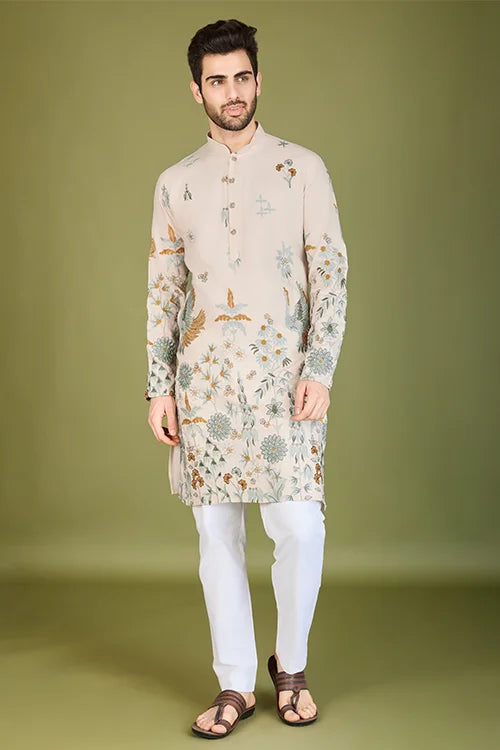
The challenge is balance. A mirror-work kurta can look refined or overly busy depending on colour, scale, bottom, dupatta and footwear. Men also need to consider comfort around the collar and cuffs, because reflective embellishment may sit close to the skin. This guide covers the main 2026 styling directions for weddings, sangeet, Navratri, mehendi and festive events.
Why mirror work suits menswear
Mirror work gives a kurta visual texture without requiring multiple garment layers. Under wedding and sangeet lights, small reflective points make the surface more dynamic. This is useful for men who do not want a heavy sherwani but still want their outfit to feel special. A simple kurta-pajama shape can become event-ready through mirror placement alone.
The trend also works across colours. Beige and ivory make mirror work subtle. Navy and black make it dramatic. Mustard and green feel festive. Maroon feels traditional. This flexibility means men can choose a colour that fits the event rather than feeling locked into one “mirror-work look.”
Beige: the easiest modern option
Beige is particularly strong because it makes the mirrors visible without creating high colour intensity. It suits daytime weddings, mehendi, engagement lunches and destination functions. Pair beige with an ivory or white bottom for a clean tonal base. Add tan or brown mojaris and a cream or muted-gold dupatta if you want more ceremony.

For an understated wedding-guest look, skip a necklace and use a classic watch. For a more traditional groom-side outfit, add a stole or dupatta and a small brooch if the kurta construction supports it. The beige base is adaptable enough that one kurta can be worn several different ways.
Mustard for haldi and festive functions
Mustard naturally suits haldi, Navratri and daytime festivities. Mirror work keeps the colour from looking too flat in photographs. Pair it with white or cream bottoms and brown, tan or gold-toned footwear. If the outfit includes a matching dupatta, let that provide the second layer rather than adding a busy jacket.

At a haldi event, practical fabric and washable or manageable footwear matter because colour and turmeric can travel. Choose accessories you are comfortable protecting, and do not wear delicate shoes if the celebration is likely to become playful.
Olive and green for Navratri
Green is a natural festive colour and works well under Garba lighting. An olive mirror-work kurta can feel more sophisticated than very bright green, while a fresh green cotton kurta looks energetic for Navratri. Pair green with white for contrast or keep the bottom tonal for a more contemporary look.
For Garba, footwear should prioritise grip and comfort. Juttis or secure traditional shoes are better than anything slippery. Choose a kurta length that allows unrestricted leg movement, and make sure side slits are comfortable before the event.
Maroon for weddings
Maroon carries natural wedding formality. Mirror work gives it highlights without requiring a contrasting jacket. Pair with ivory or white bottoms, a dusty-maroon or beige dupatta and brown or antique-gold footwear. The colour works especially well for sangeet and evening wedding events where deeper tones photograph richly.
Navy and black for evening functions
Navy and black make mirror details stand out strongly. These colours suit receptions, cocktail-style sangeets and late-evening celebrations where family customs allow. Keep the bottom matching for a long monochrome line, or use ivory to make the kurta more traditional. Black leather-style formal shoes can work for Indo-western styling, while mojaris keep the look distinctly ethnic.
Kurta only, kurta-bottom or kurta-dupatta set?
A kurta alone gives maximum flexibility because you can choose white pants, churidar, straight trousers or a dhoti-inspired bottom. A kurta-bottom set creates a cleaner coordinated look. A dupatta increases occasion value without the weight of a jacket. Choose based on function rather than assuming more pieces always mean better dressing.
For Garba and long sangeet dancing, fewer loose layers are easier. For a wedding ceremony or groom-side entry, a dupatta can add drama. For a family dinner, the kurta and bottom may be enough.
Bottom options
White straight pants are the safest partner for mustard, green, maroon, beige and navy. Churidar gives a more classic silhouette. Tonal pants create a contemporary monochrome look. Black trousers can work with black or jewel-tone kurtas for a more fusion direction. Ensure the bottom rise and length allow sitting cross-legged if the ceremony requires it.
How to wear a dupatta
Men’s dupattas can be draped over one shoulder, around the neck with both ends falling forward, or across the body depending on the garment and event. Keep it simple when the kurta already has mirror work. A printed dupatta can add colour, but avoid another high-density reflective surface that competes with the kurta.
Jackets and koti layers
A mirror kurta can be layered with a plain or lightly textured Nehru-style jacket, but check whether the jacket hides the strongest part of the work. If most mirror embroidery sits on the front chest, a closed jacket may defeat the purpose. An open koti can frame the kurta while preserving detail.
Footwear
Mojaris and juttis are the easiest traditional options. Brown and tan suit beige, mustard and green; black suits navy and black; cream and gold-toned footwear can work for more ceremonial outfits. For a dance-heavy event, break in footwear before wearing it for several hours.
Accessories for men
A watch, ring, brooch, mala or turban can all add interest, but mirror work already functions as an accessory. A groom or close family member may want a layered necklace or safa, while a guest may look more polished with only a watch. Avoid wearing several large metallic pieces across the same chest area as dense mirror embroidery.
Hair, beard and grooming
Sharp grooming becomes more visible when the kurta itself is detailed. Clean neckline edges, a well-maintained beard or shave and styled hair make a significant difference. Choose fragrance carefully and avoid spraying directly onto delicate embroidered surfaces.
Fit checklist
- Shoulder seams should sit close to the natural shoulder.
- The collar should not rub uncomfortably against embellishment.
- Armholes should allow full movement for dancing.
- Side slits should support walking and sitting.
- Sleeves should not pull across the elbow.
- Kurta length should work with your height and chosen bottom.
- Try the complete outfit before the function.
Wedding guest formulas
Day wedding: beige mirror kurta, ivory pants, tan mojaris and a classic watch. Sangeet: navy or maroon mirror kurta, tonal bottom and secure footwear. Haldi: mustard kurta, white bottom and minimal accessories. Navratri: green mirror or embroidered cotton kurta, easy pants and dance-friendly juttis. Reception: black or navy with a sharper tonal bottom and formal ethnic shoes.
How mirror placement changes comfort
Before buying, study where the reflective work sits rather than judging only the total amount. Mirror detailing across the centre chest is usually easy to wear because that area moves less. Dense work at the collar can feel more noticeable against the neck, while mirrors near cuffs may contact a watch or bracelet. Work around the lower side seam can also interact with the arms during Garba. These are not reasons to avoid the garment; they are reasons to check lining, finishing and placement carefully.
For dance-heavy events, run a movement test at home. Raise both arms, clap above shoulder level, rotate the torso and take several wide side steps. If the kurta pulls strongly at the chest or the work catches against itself, adjust the size or layering before the event. A comfortable kurta will always look more polished because the wearer is not protecting the outfit all evening.
Lighting makes mirror work behave differently
In daylight, mirrors appear as crisp points against the fabric and colour becomes the main story. Under warm wedding lighting, the reflective detail becomes stronger. Under moving sangeet lights, even a restrained mirror pattern can become dramatic. That is why a beige or cream mirror kurta can look subtle at an afternoon engagement and much richer at an evening function without any styling change.
For photographs, avoid adding several highly reflective accessories at the same time. If the kurta already throws small highlights, a matte dupatta, clean footwear and one metallic accessory create balance. This also helps the face remain the focal point in flash photography.
A three-function rewear plan
Think beyond one wedding when choosing colour. A beige mirror kurta can be worn first with ivory pants and a muted dupatta for a ceremony, later with tonal trousers and no dupatta for a festive dinner, and again under a plain darker koti for another wedding. A mustard set can move from haldi to Diwali by changing the dupatta and footwear. Navy can shift from sangeet to reception through a tonal bottom and more formal shoes.
This modular approach is especially useful when building a men’s ethnic wardrobe. White and ivory bottoms, one brown pair of mojaris, one black pair and a neutral jacket can support several kurtas. Instead of buying a complete accessory kit for every colour, repeat good basics and let the kurta supply the visual change.
Coordinating men without identical uniforms
For brothers, friends or groomsmen, choose a related palette instead of one exact kurta. Beige, mustard and olive can form a warm daytime group; navy, maroon and black can create an evening group. Repeat one element—perhaps ivory bottoms, a shared dupatta colour or similar footwear—to connect the photographs. This looks coordinated while still allowing each man to choose a colour he will rewear.
Travel and garment preparation
Keep mirror-work kurtas away from rough zippers, metal shoe buckles and other embroidered garments during travel. Fold with a soft protective layer over dense work and remove brooches before packing. On arrival, unpack early and follow the garment’s pressing or steaming instructions rather than applying direct high heat. Check loose mirrors or threads before the function so any repair can be handled calmly.
Shopping online
Read whether the mirror work is embroidered, attached, decorative or described in another way. Check fabric composition, included pieces and inventory options. Compare chest measurement to a kurta you already own rather than relying only on generic size labels. Look at close-up images around the collar and cuffs to understand work density.
Common mistakes
The first mistake is adding a busy printed jacket over an already dense mirror kurta. The second is choosing tight sleeves for a dance event. The third is ignoring footwear comfort. The fourth is over-accessorising the chest with a necklace, brooch and dupatta all competing with mirror work. Finally, do not wear a kurta straight from packaging without steaming or pressing it according to care instructions; clean fall matters.
Rewear ideas
Wear a beige mirror kurta with white pants for a wedding, then with beige trousers for a festive dinner. Pair mustard with white for haldi and a darker brown bottom for Diwali. Wear navy with ivory for a traditional event and tonal navy for reception. A versatile kurta earns its place when it can cross at least two occasions.
Care
Follow the garment care label. Store mirror work away from rough surfaces that can catch. Avoid crushing dense work under heavy clothing. Do not spray perfume directly on decorative areas. When travelling, place a soft protective layer between embroidered garments and hard accessories.
Frequently asked questions
Can men wear mirror work to weddings?
Yes. Beige, maroon, navy, black, green and mustard mirror kurtas can all suit weddings depending on time and role.
Is mirror work only for Navratri?
No. It is also strong for sangeet, mehendi, receptions and festive events.
Which colour is easiest?
Beige is highly versatile, while navy is an excellent evening option.
Do I need a dupatta?
No. A dupatta adds ceremony but a well-fitted mirror kurta and bottom can look complete without it.
Can I add a Nehru jacket?
Yes if the jacket does not hide or fight the mirror placement.
Which shoes work?
Juttis, mojaris and refined ethnic shoes are dependable. Choose grip and comfort for dance events.
Can mirror kurtas be minimal?
Yes. Choose a monochrome colour and keep accessories restrained.
What matters most when buying online?
Chest fit, shoulder fit, included pieces, fabric and the placement of decorative work.
Final thought
Mirror work gives men a way to participate in the visual energy of 2026 wedding fashion without moving into heavy sherwani territory. Choose a colour that matches the event, keep the rest of the outfit disciplined and prioritise movement. When fit is right, a mirror kurta can do almost all the styling work by itself.